Every sports photographer has a moment where they step onto a new field and realize they have to throw their usual playbook completely out the window. For me, that moment happened at Biddle Field on October 11th, covering my first-ever collegiate field hockey match as Dickinson College took on Swarthmore College.
If you look online for guides on how to photograph field hockey, you won't find much. So, going into the match, my logic was simple: treat it like soccer. I figured I'd hang out directly behind the goals, let the offense drive straight at me, and capture those explosive, front-facing frames.


The Rookie Mistake: Directly Behind the Cage
That strategy worked beautifully... for about five minutes.
That was right when the referee sprinted over to politely, but very firmly, let me know that standing directly in the path of a rock-hard plastic ball flying at roughly 80 miles per hour wasn't exactly a sustainable business model. Lesson learned. I quickly shifted off to the side of the cage, adjusted my angles, and spent the rest of the afternoon discovering just how fast, physical, and unique this sport really is.

Driving the Circle
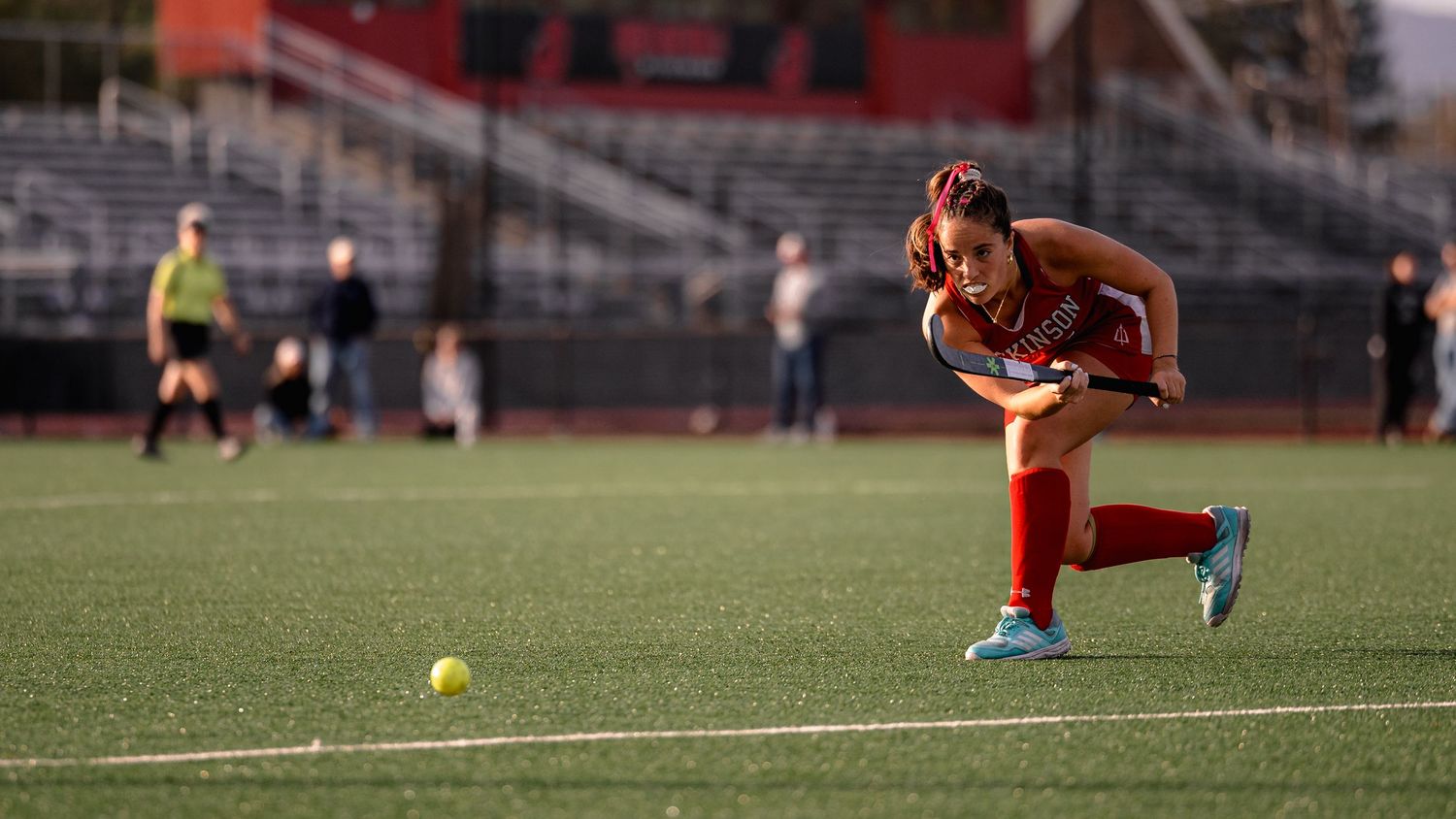
Once I relocated to the side of the goals, the game opened up in a completely different way. Field hockey is a game of relentless pacing and sudden bursts of territory control. Capturing the offense driving down the sideline and cutting hard into the circle requires a lot of tracking. By keeping both eyes open and panning with the lead attacker, I was able to freeze the exact second she looked up to find an open lane through Swarthmore’s backline. The vibrant crimson jerseys against the green Biddle Field turf gave every frame an incredible pop.


The Pure Physicality of the Turf
One thing that surprised me right away was the sheer physicality of the sport. Sticks are flying, turf is kicking up, and the battles in the midfield are pure grit. But what makes it fascinating is how it balances that high intensity with a strict culture of safety.
The game is broken up into four 15-minute quarters, and unlike football, the teams don't swap sides after every whistle—they only flip at halftime. The wildest transition to witness is the penalty corner. The entire match grinds to a sudden halt, defensive players throw on protective face gear in a matter of seconds, and then the whistle blows and it’s right back to a high-speed collision course.
Gear Breakdown: Choosing the Right Glass
For this match, I was running my trusted 70-200mm lens. Because a field hockey pitch is more compact than a standard soccer field, a 70-200mm is completely doable and lets you capture a ton of the environmental action. However, looking back at the gallery, this is a sport that heavily rewards a longer focal length.
If I were shooting this matchup again today, I'd bring out the 100-400mm glass. When you're forced to stay a bit further back from the sidelines for safety, having that extra reach lets you crop past the chaos and lock straight onto the players' faces to catch the raw determination and focus in their eyes.
Capturing the Energy
Whether it's your first time shooting a sport or your hundredth, the goal stays the same: capture the energy that makes the game special. Massive shoutout to the Dickinson and Swarthmore athletes for putting on an absolute clinic on the turf!